
Executive summary
Mobility is slowing down. America’s largest cities are losing residents. But that’s only half the story. While aggregate data shows net outflows from major metros, CENSAI’s population intelligence reveals critical nuances.
- Submarkets are growing in big cities experiencing decline.
- Midsize cities continue to attract sustained inflows.
- Growth is happening at increasingly granular geographic levels.
- Real estate opportunities likely exist in these locales.
The macro narrative: A nationwide slowdown
Domestic migration volume has declined since 2021. In the first half of 2025, total mover volume was the lowest observed in eight years.
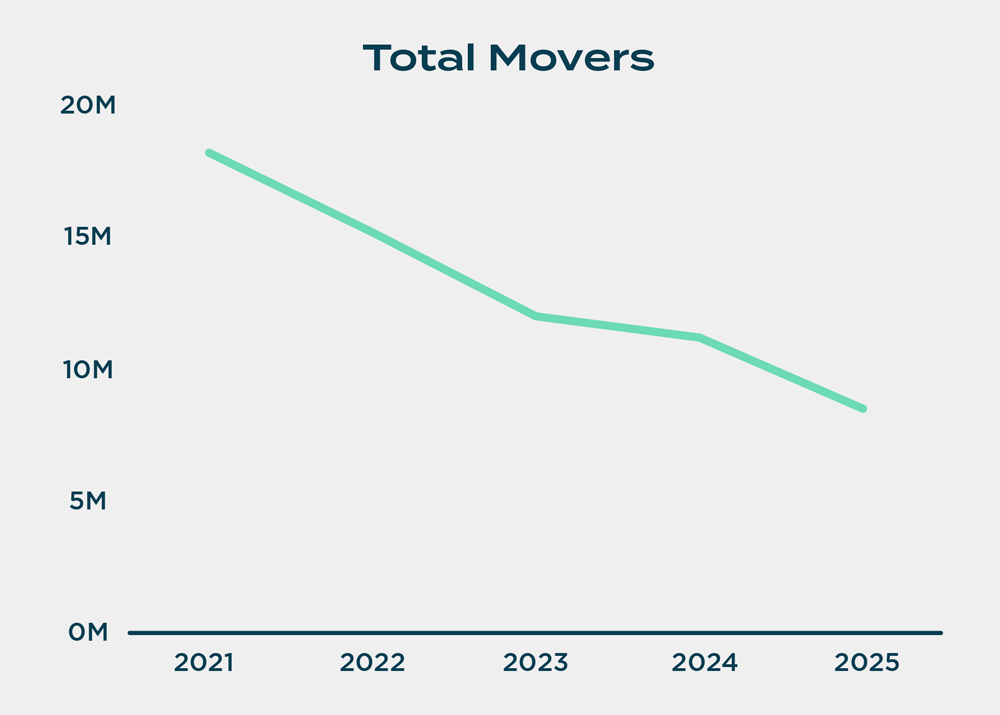
The key question is not whether Americans are moving. It is where they’re moving. CENSAI data shows that migration trends are becoming more localized.
Population drop-offs in major metros
Net migration data for 2025 resembles a waterfall as metros cross into the largest population tiers. Cities above the 97th population percentile are experiencing steep net outflows. Meanwhile, cities in the 75th–95th percentile range show sustained gains.
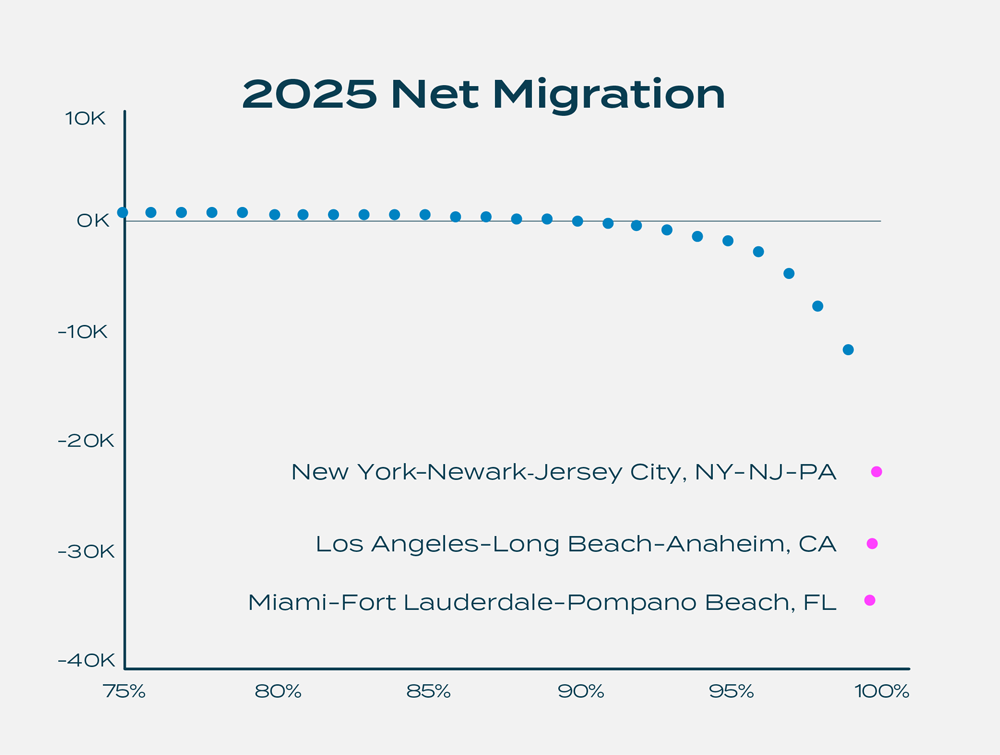
This pattern has persisted since COVID. Gateway markets like New York City, Chicago, Los Angeles, and Miami continue to experience aggregate outflows. The ongoing exodus from major markets isn’t news. What’s notable is that many movers aren’t going far. The migration momentum persists within midsize and secondary markets.
The granular reality of intracity growth
Migration does not happen at a single geographic level. It unfolds across layers of hierarchy: block, zip code, county, CBSA, state, and country.
A metro can show negative net migration while masking significant intracity movement. Take Los Angeles as an example. At the CBSA level, it shows a large population loss in 2025. But at the zip-code level, clusters of neighborhoods are growing rapidly.
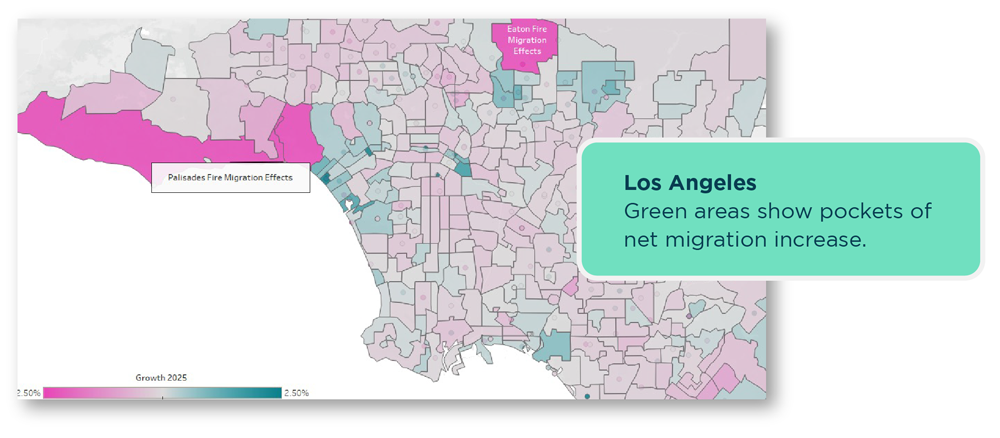
In other words, residents may not be leaving the region. They’re prioritizing more desirable parts of town that offer greater safety, affordability, or opportunity. Similar micro-growth pockets appear in other large CBSAs currently classified as losing markets.
For investors, this distinction matters. And it’s easy to miss if you’re not looking closely.
Migration winners and watch lists
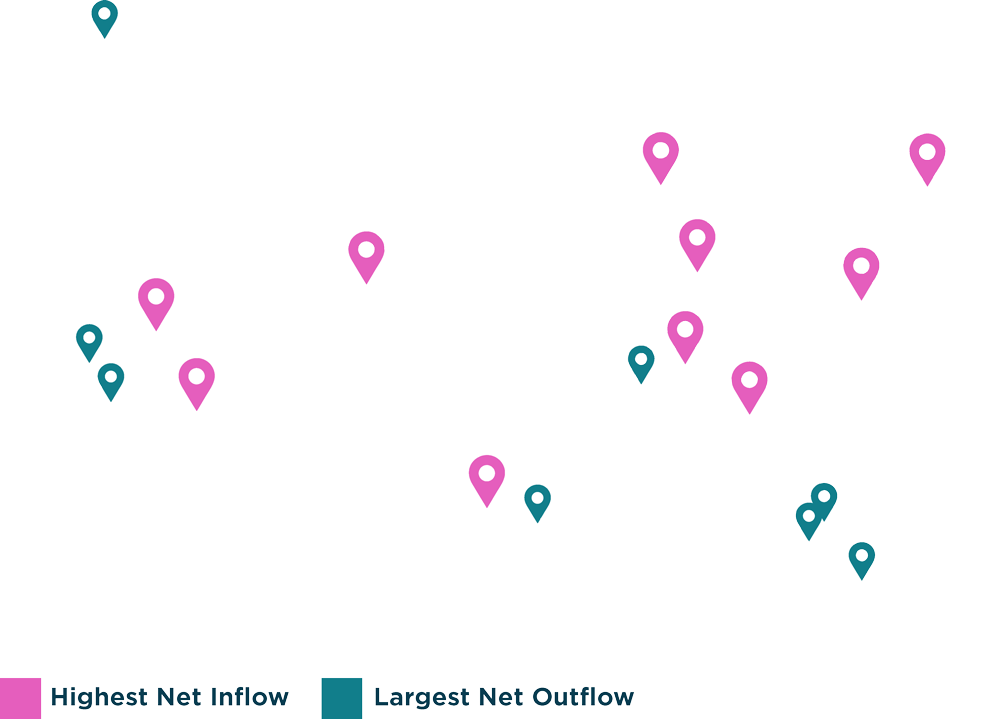
Among the largest CBSAs, the following top 10 metros rank highest for positive net migration.
- 1. Austin
- 6. Hartford
- 2. Milwaukee
- 7. Richmond
- 3. Indianapolis
- 8. Nashville
- 4. Las Vegas
- 9. Denver
- 5. Phoenix
- 10. Atlanta
By contrast, the largest net outflows are occurring in the following metros.
- 1. Miami
- 6. Houston
- 2. Tampa
- 7. San Diego
- 3. Seattle
- 8. San Francisco
- 4. San Jose
- 9. Orlando
- 5. Los Angeles
- 10. Memphis
Even within these losing markets, population flows are redistributing rather than disappearing. For example, movers leaving Miami often head to Orlando, Port St. Lucie, Tampa, and Jacksonville. Austin continues to attract movers from within Texas, including Houston, Dallas, and San Antonio.
Forecasts through 2027
CENSAI’s eight-quarter forecast model indicates that post-COVID migration trends will likely hold on through 2027.
In Florida, we expect net outflows from Miami, Tampa, Orlando, and Jacksonville. Meanwhile, population growth is expected to concentrate in adjacent markets such as Ocala, Lakeland, Winter Haven, and The Villages community.
Beyond Florida, growth clusters are projected across the Piedmont Atlantic megaregion, upper Northeast, northern Midwest, Texas Triangle, and portions of Cascadia.
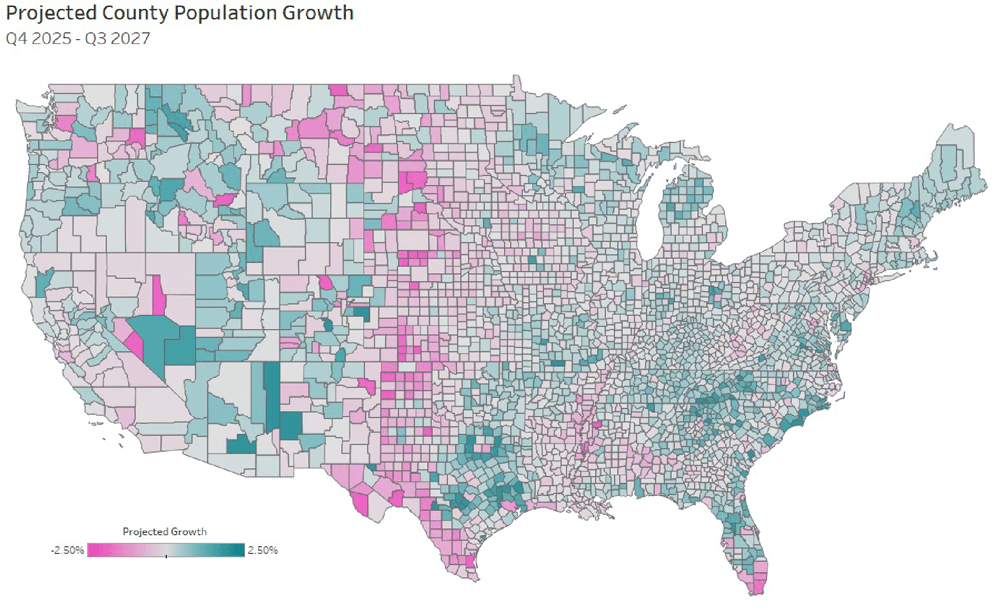
CENSAI also forecasts an outflow streak across the western part of the Midwest. This pattern resembles the traditional city-bound migration trends of the 20th century. But the overarching theme remains: Waves of movers from the largest urban cities and rural areas are concentrating in small and midsize metros nearby.
Takeaways for real estate and investment strategy
- Metro-level insights can obscure signs of high-growth clusters in submarkets.
- Investors relying on headlines or superficial analyses will risk overlooking valuable opportunities.
- Forward-looking data is essential for identifying opportunities before market prices adjust.
- Granular migration analysis is more critical than ever for due diligence and portfolio strategy
CENSAI enriches migration analysis
The CENSAI platform integrates migration, demographic, and economic insights at the geographic resolution required for making strategic investment decisions.
- Inflows, outflows, and net migration across CBSAs, counties, zip codes, custom-defined boundaries, and even multifamily properties
- Demographic and economic indicators to contextualize movement
- Historical migration trends going back to Q1 2018
- Migration forecasts up to eight quarters ahead
Discover more about how CENSAI population intelligence can guide your investment strategy.